
When Does a Heat Pump Water Heater Need to Be Ducted?
Most retrofit heat pump water heater (HPWH) installations in the Northwest don’t require ducting. But in small or confined spaces, airflow and comfort concerns can make additional interventions necessary.
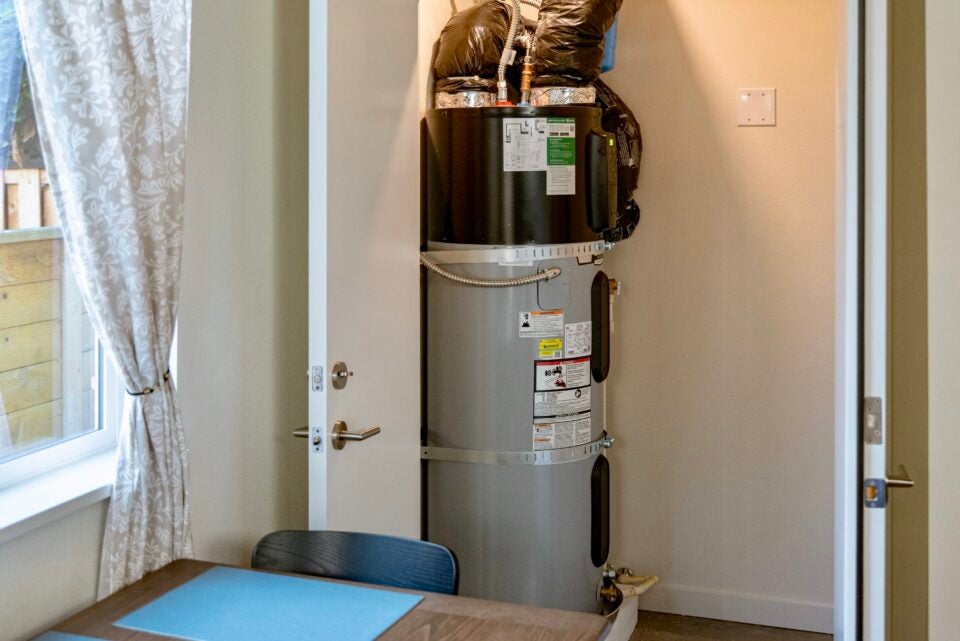
For most retrofit heat pump water heater (HPWH) installations in the Northwest, it is not necessary to redirect intake or exhaust air using ducts.
In the basements, garages, and utility rooms where they are often located, HPWHs operate efficiently without any additional interventions. Some installations in small or confined spaces, however, may benefit from ducting or other airflow improvements to maintain performance and avoid comfort concerns. Understanding when ducting (or simpler solutions like louvers or door undercuts) is sufficient can help you avoid unnecessary complexity while still delivering a successful installation.
It’s All About the Heat Source
Given the way HPWHs work by moving heat from the surrounding air into the water tank, the installation environment matters more than it does for a standard electric resistance water heater. The unit requires sufficient airflow from which to extract heat, along with a place to expel cooler exhaust air. According to NEEA research, HPWHs installed in spaces as small as 450 cubic feet—for example, a 6-by-8-foot utility room with 9.5-foot ceilings—can work efficiently with minimal temperature change to the ambient air in the adjacent living space. But to avoid significantly cooling smaller enclosed spaces to the point where the HPWH needs to rely on electric resistance backup heating, measures like louvers, transfer grilles, door undercuts, or ducting may need to be introduced.
Here’s how you can determine whether an HPWH installation space can provide enough thermal resource through airflow improvements or ducting:
Start with Simple Airflow Fixes
Before considering ducting, evaluate whether a simpler solution can increase airflow to the space. In retrofit applications, these approaches may be sufficient:
- Adding louvered doors or transfer grilles
- Increasing door undercuts
- Opening the space to an adjacent room or larger mechanical area
- Positioning the unit to improve airflow circulation
These measures can help the HPWH access a larger volume of conditioned air while keeping the installation relatively simple.
When ducting makes sense
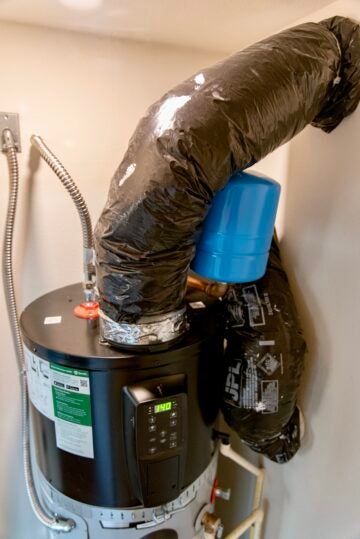 Ducting is typically best reserved for installations where airflow improvements alone will not adequately address space limitations or occupant comfort concerns. For installations adjacent to occupied living or working spaces where discharged cool air may create comfort complaints, or situations where directing exhaust air to a nearby space can improve intake airflow access, ducting may be necessary. To make ducting easier, many unitary HPWHs now include ducting adapters or manufacturer-approved kits.
If you are using ducting, first and foremost: be sure it does not break the building envelope. Ducting should remain within conditioned space whenever possible. Keep ductwork runs as short and simple as possible, because excessive length, multiple elbows, or restrictive termination fittings increase static pressure and reduce airflow, which can negatively affect performance.
Customer comfort matters
The cool exhaust air produced by a HPWH can be a perceived comfort issue, particularly during heating season. However, ducting is not always necessary to redirect cool air: there are HPWH models with a variety of exhaust configurations, including top, left-side, and right-side discharge. Choosing a model that directs cool air away from high-traffic areas can often resolve comfort concerns without additional ductwork.
Similarly, misconceptions exist about HPWHs “stealing” heat from the home’s space heating system. In practice, the interactions between HPWHs and HVAC systems are usually manageable—it’s often as simple as avoiding discharging cool air near the thermostat. Ultimately, normal internal heat gains throughout the home typically offset any localized cooling effects before they impact space conditioning.
In fact, research has shown that overall home energy consumption decreased after installing a HPWH, regardless of whether the home used electric resistance heating, a heat pump, or a gas furnace for space conditioning.
The Bottom Line
Ducting is not automatically required for a successful HPWH installation. In many cases, adequate airflow can be achieved through simple measures like louvers, transfer grilles, or door undercuts. When those strategies are not enough, properly designed ducting can be an effective solution that allows HPWHs to perform well while preserving homeowner comfort.
The key is to match the solution to the space: an evaluation of room volume, airflow, and occupant comfort will allow you to confidently determine which installation scenarios will benefit from the addition of ducting.