
Burks Mechanical Builds a Business Advantage With Heat Pump Water Heaters
For Pete Burks, heat pump water heaters (HPWHs) are an efficient option that help him stand out from the competition and prepare for growing demand. Now that he’s invested in HPWHs, here’s what he thinks other installers should know.
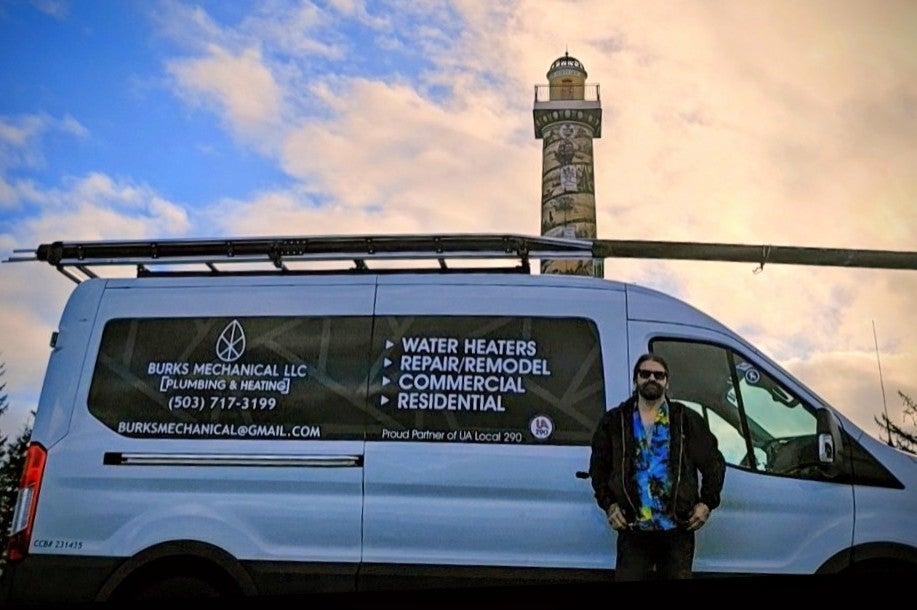
For Pete Burks, owner of Burks Mechanical in Astoria, Oregon, the value of heat pump water heaters is practical: they give him a valuable option to offer customers and an opportunity to stand out in a market where reputation matters.
“Burks Mechanical is just me, a one-man show out of Astoria, Oregon,” Burks said. He serves customers in Northwest Oregon with work that has included residential renovations, service calls, and water heater installations. As remodeling work has slowed over the last few years, service work has become even more important. “People still need water heaters, and people love to save money on their electric bill every month,” Burks said.
Working in a coastal community shapes the way Burks thinks about every job. Astoria is a smaller town, and the contractor business is highly personal—customers talk and referrals matter. “Most of my work has come from word of mouth,” Burks said. “If I didn’t have that, I probably wouldn’t have anything.”
For Burks, earning that reputation starts with how he treats customers and how he stands behind the work. “Doing right by the customer starts with a quality install, and if there’s a problem, you have to point it out. You need to provide value.” His approach is simple: “Talk to them like they’re human. Give them a good installation, give them something that you can back up, and just give them a fair price.”
This customer-first mindset is part of why Burks has become interested in heat pump water heaters. After learning about heat pump water heaters, he sees them as one more solution he can bring to the table—especially as customers become more aware of efficiency and utility rebates.
A problem-solver’s path to energy efficiency
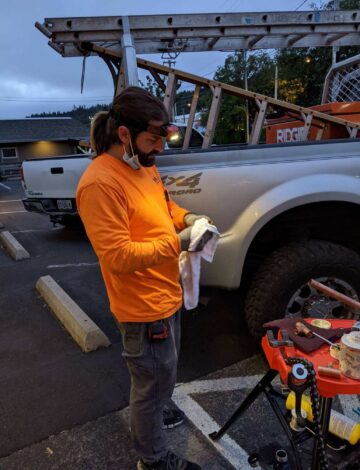 Burks did not set out to become a plumber. He grew up on the Olympic Peninsula and started logging when he was 20. After several years in the woods, with a young family and limited opportunities to move up, he answered a newspaper ad for a plumbing job. “I’ll try plumbing ’til I find something better,” he remembers thinking.
Instead, plumbing became what he calls “an accidental great decision.” He joined the union, learned the trade, worked as a pipefitter, and eventually opened Burks Mechanical in 2020.
His varied background has informed his approach to new technology: logging taught him to solve the problem he could observe and see; pipefitting gave him experience with heavier mechanical systems; and classes on auto mechanics and critical thinking taught him to diagnose a problem before trying to fix it.
This way of thinking helped him approach heat pump water heaters with an open mind and less hesitation than other contractors. When a customer asked him to install one shortly after he opened his business, his response was not to turn away from the job—it was to study the product. “I’ll do it, but I have to read up,” he remembers thinking.
The first few installations came with a learning curve, but as he gained experience, he saw that the technology was not that mysterious. “It’s basically like an air-to-air heat pump,” he said. “You’re just transferring heat.”
From there, Burks began to see an opportunity.
“I took some notes on that first install. The second one was better, and it was like, ‘man, they’re great.’ You take time on your first couple of installs, then you can make up your mind about whether or not you like them. I think this willingness to learn separates me from some of the other guys.”
Technology worth learning
Knowing every homeowner has a different budget, home and set of priorities, Burks has learned to be intentional about how he positions heat pump water heaters. They’re not necessarily the go-to for every installation: “I think I’d lose sales if I tried to make anything my default. What I can do is provide the customer with facts: ‘here are your problems, and here’s a list of solutions.'”
That makes HPWHs a higher-efficiency option Burks can explain clearly, price honestly, and install correctly when the application makes sense.
Burks has noticed growing demand for energy-efficient water heating, which he sees as an opportunity for smaller contractors. Bigger crews do not always have the willingness or incentive to learn a different technology. Smaller outfits like Burks’ can choose to carve out a niche and make HPWHs one of their specialties.
In one recent installation, Burks helped connect the customer with a utility rebate that brought down the upfront cost. The customer paid about $600 more than they would have for a standard electric water heater—but they got a more efficient system that would quickly pay for itself in savings. “It was great,” Burks said. “I felt good about it. He felt good about it.”
Not every customer responds to the same pitch. Some care most about return on investment; others have a firm upfront budget. “Some people couldn’t care less about the upfront cost if they know that it’s going to pay itself off,” Burks said. “Other people can’t afford the upfront cost, so that’s where you remind them about those rebates.”
For contractors, Burks said, heat pump water heaters are not impossibly complicated, but they are different enough from an electric resistance water heater that installers need to pay attention.
“They’re not quite as straightforward,” he said. “But they’re also not the wizardry that some people think they are. They do live up to the promise of efficiency.”
For contractors who have not installed heat pump water heaters, Burk’s advice is to start with the basics: get familiar with the installation manual, check the sizing charts, and pay close attention to placement, airflow, and condensate.
Airflow is one detail Burks found easy to overlook. A Hot Water Solutions field specialist helped Burks understand those considerations more clearly. “They’re so responsive every time I have a question, and they went over a couple of airflow things that I really didn’t know,” Burks said. “Easy enough. That was pretty useful.”
Eventually, Burks concluded that HPWHs are not difficult; they just require the same disciplined approach that should apply to all quality water heater installations. “If there are any questions—on any installation—you should probably read the manual,” Burks said.
Committing to heat pump water heaters
Asked what he would tell another plumber considering heat pump water heaters, Burks is quick to crack a smile and joke: “Don’t do it. Leave them to me.”
Getting more serious, Burks said, “You can find the rebates, do a little bit of paperwork up front, and make yourself great money. They’re great technology. They’re very efficient. People are into the savings. You just have to be willing to learn.”
That is the core of why Burks has invested in heat pump water heaters: The technology gives customers another efficient option, rebates help make the investment pencil out, and his business can build credibility before the market becomes more crowded.
When asked if contractors who are willing to learn the technology now will have an advantage later, Burks replied, “Absolutely. And I let my customers know they’re getting ahead of the game.”